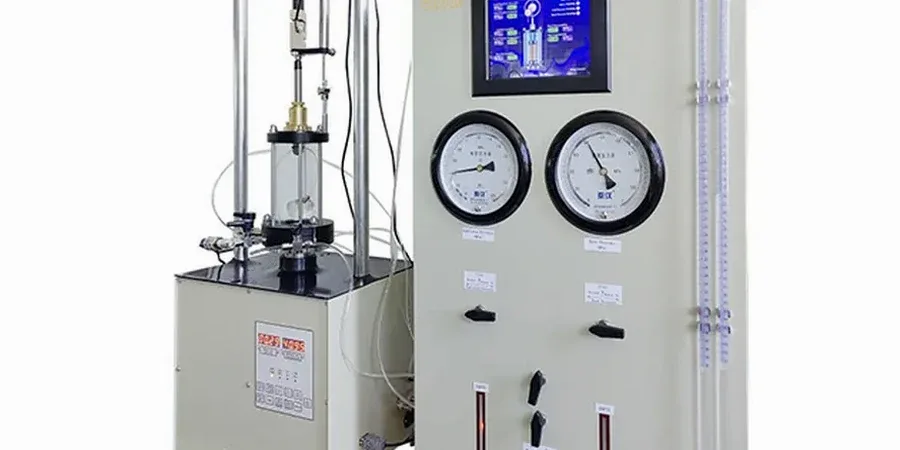
In Lubbock, we often see engineers rely on generic bearing capacity assumptions only to discover site-specific shear strengths don't match the borelog. The Upper Caliche and the Blackwater Draw Formation silty clays can behave quite differently under load, and a simple pocket penetrometer won't tell you the effective friction angle or undrained cohesion you actually need. That's where the triaxial test comes in. We run consolidated-undrained (CU) and unconsolidated-undrained (UU) programs on undisturbed Shelby tube samples extracted from local boreholes, following ASTM D7181. For projects east of I-27 where the sandier lenses appear within the caliche, we've found that a CPT test helps define the stratigraphy before selecting specimen depths, especially when the transition from stiff clay to weakly cemented caliche can be subtle in the field log.
A site-specific effective friction angle from a CU triaxial test can reduce a mat foundation thickness by 8-12 inches compared to conservative assumed values, saving concrete on Lubbock projects.
Local ground factors
A common mistake on Lubbock projects is running only unconfined compression tests on fissured caliche or silty clay, then applying those numbers directly to a bearing capacity equation. Fissures close under confining pressure in the triaxial cell, producing higher shear strength than the unconfined cylinder suggests – but if the designer never sees the triaxial data, the foundation ends up oversized and the owner pays for unnecessary concrete. The opposite risk occurs in saturated clay lenses where rapid loading during construction generates excess pore pressure and temporary strength loss; a UU triaxial test captures that undrained condition correctly, while a quick unconfined test overestimates the available shear resistance. We've seen retaining wall designs near the Texas Tech campus area revised after triaxial results showed the actual drained cohesion was lower than assumed from standard penetration resistance alone. For deeper excavations, combining the triaxial data with slope stability analysis ensures the factor of safety accounts for the correct strength envelope, not a textbook correlation.
Common questions
How much does a triaxial test cost in Lubbock?
A three-point CU triaxial envelope typically ranges from US$1,760 to US$2,980 depending on sample condition, required confining stress levels, and whether we need to run multi-stage procedures to conserve material. The price includes specimen trimming, backpressure saturation, consolidation, shear, and the final report with Mohr-Coulomb parameters and pore pressure plots.
Do you need undisturbed samples for the triaxial test, and how are they collected?
Yes – we require undisturbed Shelby tube samples, typically 3-inch diameter, pushed with a drill rig through the zones of interest. The drilling crew extrudes and seals the tubes immediately, and we pick them up from the site or the driller's yard in Lubbock within 24 hours to start specimen preparation before moisture loss affects the clay structure.
How long does it take to get triaxial test results?
Standard turnaround is 7-10 business days for a three-point CU envelope, though UU tests can be completed in 5-7 days. Saturation time varies with soil permeability; the Blackwater Draw silty clays typically reach full saturation within 3-4 days under backpressure.
What's the difference between CU and UU triaxial tests, and which one do I need for a Lubbock project?
A CU test measures effective stress parameters (c' and phi') with pore pressure measurement and applies to long-term, drained loading conditions – this is what you need for most shallow foundations and retaining walls. A UU test measures total stress parameters (c and phi) under undrained conditions and is suitable for short-term stability during construction on saturated clays. We can help you select the right program based on your loading scenario and the soil description from the field log.
Can you run triaxial tests on caliche samples from Lubbock?
Yes, but caliche requires careful specimen preparation because the weak cementation can crack during trimming. We use a lathe set at low speed and trim under a mist of water to preserve the intact fabric. If the caliche is too hard for Shelby tube sampling, we can test rock core specimens, though the shearing procedure differs and we would discuss that with you before starting.