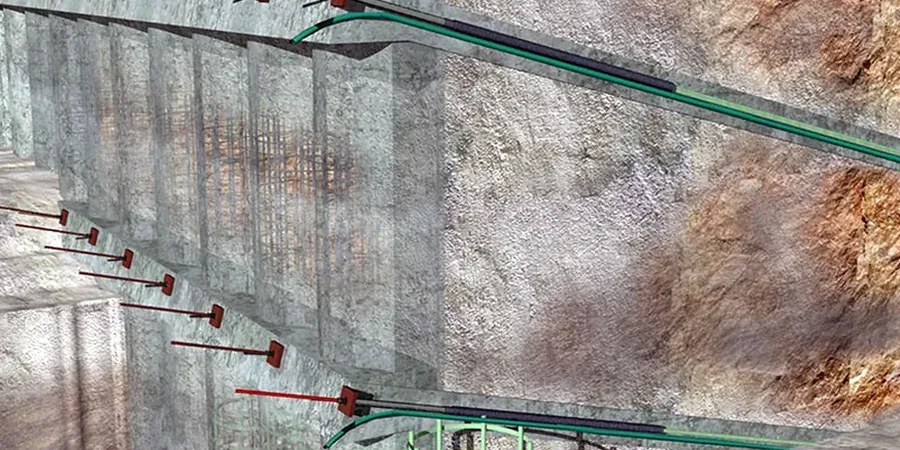
A hydraulic rotary drill rig sets up near a deep cut on the Llano Estacado. The crew threads a high-strength steel tendon into a pre-drilled borehole, then pressure-grouts the bond zone in stages. In Lubbock, where the surface clay gives way to the caliche-rich Ogallala Formation, in-situ permeability testing often guides the grout mix design, because variable moisture content in the Upper Trinity aquifer zone can affect bond strength. We design active anchors when immediate load transfer is needed for shoring, and passive anchors where ground deformation controls the tieback force. Every anchor length, inclination, and unbonded sleeve detail follows site-specific stratigraphy, and we verify capacity with proof tests on the actual production anchors before the contractor places the waler beam.
In Lubbock's caliche, a well-designed anchor bond zone can hold 50 kips or more per tendon, but only if the grout mix matches the formation's actual permeability.
Our approach and scope
Lubbock sits at roughly 3,256 feet above sea level on a plateau underlain by the Dockum Group and the Ogallala Formation. That geology creates a two-layer challenge for anchor design: an upper stratum of reddish-brown clay and silt that swells with seasonal moisture, and a lower zone of cemented caliche that can reach unconfined compressive strengths over 1,000 psi. A single project near Mackenzie Park might need a different bond length in the south side of the cut than on the north side, simply because the caliche contact dips 8 degrees. Our design process defines the unbonded length to bypass potential failure wedges, calculates the grout-to-ground ultimate bond stress from on-site pullout data, and locks off active anchors at a percentage of the design load to control wall deflection. Passive anchors, by contrast, rely on tendon elongation under service loads, and we size the double-corrosion-protection encapsulation for the sulfate-rich soils common across the Southern High Plains. This approach keeps excavation support costs predictable, because the design is calibrated to Lubbock's own stratigraphy, not borrowed from generic lookup tables.
Local ground factors
Downtown Lubbock and the areas east of I-27 toward Mackenzie Park sit on thicker alluvial clay deposits, while the southwest side of the city transitions into shallow caliche over harder carbonate rock. A contractor who assumes the same anchor bond stress in both sectors is going to see very different creep behavior. In the clay zones, passive anchors may undergo long-term relaxation if the load is not locked off correctly, causing lateral movement that can crack adjacent pavement or damage shallow utilities. In the caliche zone, active anchors drilled too close to the property line can create a tension cone that intersects neighboring footings. We address these differences by mapping the bond zone into competent material beyond any potential failure surface defined by the excavation geometry. For deep cuts near Texas Tech University, where classroom buildings are just a few feet from the shoring line, we specify incremental load testing and monitor anchor force with load cells for the first weeks after stressing. The biggest risk in Lubbock is not the anchor steel itself, it is underestimating how much the soil-grout interface varies across a single block.
Reference standards
IBC 2021 (Chapter 18: Soils and Foundations, tieback anchor provisions), ASCE 7-22 (Minimum Design Loads for Buildings and Other Structures), PTI DC-35 (Recommendations for Prestressed Rock and Soil Anchors), ASTM A416 (Low-Relaxation, Seven-Wire Steel Strand for Prestressed Concrete), ASTM C150 (Portland Cement, grout mix design basis)
Common questions
What is the difference between active and passive anchors in a Lubbock excavation?
Active anchors are tensioned after grouting to apply a predetermined load against the wall, controlling movement immediately. Passive anchors are not stressed; they develop resistance as the ground deforms and the tendon elongates. In Lubbock's caliche, active anchors are more common for deep cuts near existing buildings, while passive anchors can work well for temporary cuts in open areas where some lateral deflection is acceptable.
How much does anchor design cost for a retaining wall project in Lubbock?
Anchor design fees typically range from US$990 to US$3,470, depending on the number of anchor rows, the complexity of the stratigraphy, and whether load testing supervision is included. A typical single-tier tieback wall with 20 anchors will fall in the lower half of that range, while a multi-row anchored system with extended creep tests will be at the higher end.
Do you need a geotechnical investigation before designing anchors in Lubbock?
Absolutely. Anchor bond stress values depend directly on the soil or rock at the bond zone depth. In Lubbock, a boring with SPT sampling and laboratory strength tests on caliche cores, combined with in-situ permeability data, gives us the parameters needed to size the bond length and select the grout mix. Without site-specific data, the design would rely on conservative assumptions that often oversize the anchors unnecessarily.
What testing is required on installed anchors?
We follow PTI DC-35 recommendations: every production anchor undergoes a proof test to at least 133% of the design load, and a minimum of 5% of anchors receive extended creep testing. The acceptance criteria check both load-holding capacity and creep rate. In Lubbock's expansive clay zones, creep testing is particularly important because soil relaxation can reduce lock-off load over time if the bond stress was overestimated.