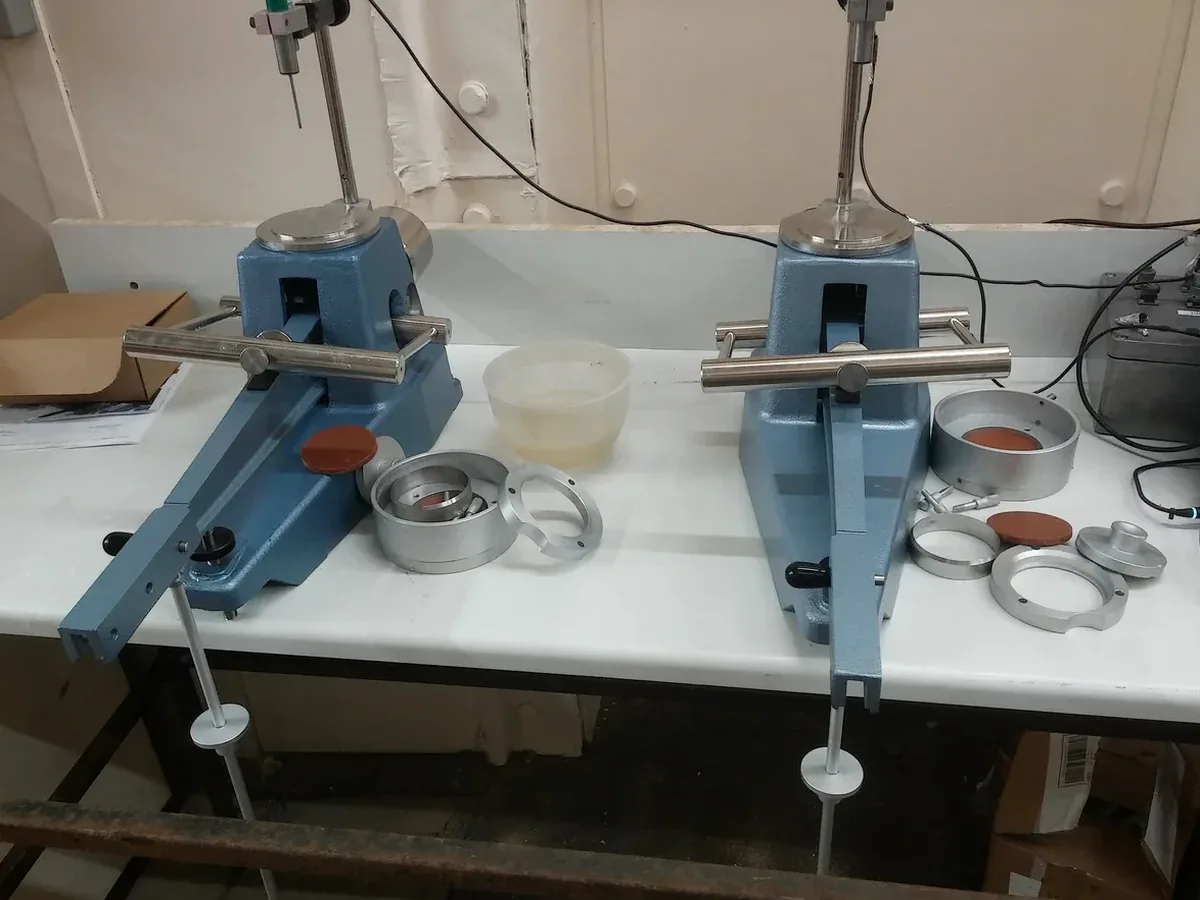
The evolution of Lubbock from a dusty railroad stop to the Hub City of the South Plains was shaped by more than cotton and Texas Tech. It was shaped by the soil, specifically the fine-grained aeolian deposits of the Blackwater Draw Formation that blanket the Caprock escarpment. When a contractor breaks ground on a new tilt-wall warehouse near I-27 or a subdivision pushes into the fringe near Buffalo Springs Lake, the first real conversation between the structure and the ground happens at the particle level. Atterberg limits testing gives us the vocabulary for that conversation. By defining the moisture contents where Lubbock's silts and clays transition from solid to plastic to liquid, we can predict how a foundation will heave during a wet winter or how a pavement subgrade will rut under construction traffic. Our lab team runs these tests not as a checklist item, but as a diagnostic tool. A grain size analysis often accompanies the Atterberg limits to complete the USCS classification, especially when dealing with the layered mixtures of clay and caliche that make the South Plains so unique.
The plasticity index is not just a number on a lab report; it is a direct measurement of the soil's capacity to hold onto water and, in Lubbock's semi-arid climate, to change volume dramatically when it finally gets some.
Local ground factors
What we observe repeatedly in Lubbock is that the most expensive geotechnical failures don't come from the deep, competent caliche layers, but from the shallow, highly plastic clay seams that lenses within the upper ten feet of the profile. A contractor will excavate for a slab-on-grade, see 'good-looking brown dirt,' and decide to skip the plasticity index test to save a few days. That decision backfires when the first major rain event saturates the subgrade and the floor slab begins to telegraph every crack pattern in the clay below. The expansive potential of a soil with a liquid limit above 50 and a plasticity index over 25 is not a theoretical concern here; it is the primary cause of distress in lightly-loaded structures. We've sampled clays from the draws feeding into the North Fork Double Mountain Fork Brazos River that barely pass a thumb penetration test when dry but flow like soft butter at 35% moisture. Without knowing the Atterberg limits, a geotechnical report is just a guess. For sites near the playa lakes where groundwater perches seasonally, we often recommend pairing this data with an in-situ permeability test to model how quickly saturation fronts can move through the foundation zone.
Common questions
How much does Atterberg limits testing cost on a typical Lubbock residential lot?
For a single bulk sample requiring liquid and plastic limit determination, the lab fee typically falls between US$50 and US$100. The exact cost depends on whether the sample is part of a larger suite of tests. We always recommend confirming the scope with your geotechnical engineer, as testing multiple horizons from a single borehole will increase the total number of samples.
Why do Lubbock soils have such high plasticity compared to other parts of Texas?
The high plasticity is largely driven by the mineralogy of the Blackwater Draw Formation. Over thousands of years, wind deposited fine silt and clay particles derived from the weathering of the Rocky Mountains. Within these deposits, the presence of smectite clay minerals, which have a tremendous capacity to adsorb water, pushes liquid limits well above 50 in many localized lenses. This is why a lot can have a plasticity index exceeding 30 while the lot next door tests much lower; it all comes down to the concentration of these expansive clay seams.
Do you need a specific sample size to run the Atterberg limits test?
Yes. We require a minimum of 300 grams of material that has been air-dried and pulverized sufficiently to pass the No. 40 (425-μm) sieve. It is critical that the sample is representative of the fine fraction of the soil, not just a handful of sand. If the sample is taken from a split spoon during an SPT boring, we will process it in our lab to remove the coarse fraction before performing the test according to ASTM D4318.