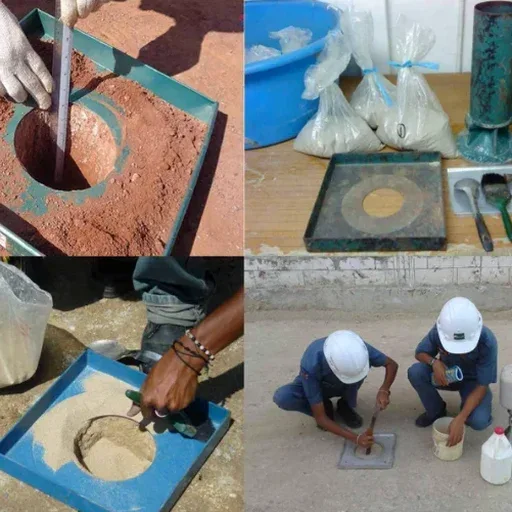
Compaction verification on Lubbock's expansive clays isn't just a box to check—it's what separates a slab that stays flat from one that heaves with the seasons. ASTM D1556 and project specs typically demand 95% of standard Proctor density under footings and behind retaining walls, and the sand cone test remains the most direct way to prove it. We run these tests across Lubbock County, from downtown infill projects to large-lot residential pads near Loop 289. The procedure is straightforward: dig a small hole, weigh the excavated soil, fill the void with calibrated Ottawa sand, and calculate the in-place density. What makes it relevant here is the local soil profile—reddish-brown clay over caliche layers that can trick the untrained eye into thinking compaction is adequate when it isn't. For deeper stratigraphy beneath pavements, we often pair the sand cone with SPT drilling to correlate surface compaction with subsurface strength.
On Lubbock's expansive clays, a passing sand cone test at 95% Proctor means the difference between a stable slab and a call-back two summers later.
Our approach and scope
The sand cone apparatus we use on Lubbock jobsites is a metal base plate with a six-inch diameter opening, a one-gallon plastic or glass jar filled with uniformly graded Ottawa sand, and a cone valve assembly that controls the flow. The base plate sits flush on the compacted surface—whether that's a select fill lift, a utility trench backfill, or a building pad—and the sand runs until it fills the excavated hole and the cone. We weigh everything before and after, and the difference gives the volume of the hole. Divide the moist mass of the removed soil by that volume, correct for moisture content from a representative sample, and you have the dry density. Lubbock's silty clays tend to hold moisture near optimum for short windows after placement, so timing the test within an hour or two of compaction is critical. The method follows ASTM D1556, and our technicians calibrate the sand density daily using a standard mold and the same sand batch that goes to the field.
Common questions
What's the typical cost for a sand cone density test in Lubbock?
Field density testing with the sand cone method in the Lubbock area generally runs between US$90 and US$140 per test point, depending on the number of points per mobilization and travel distance from our lab. Most residential pad jobs require 4 to 8 points per lift, and we can deliver a flat-rate quote once we know the project size.
How long does a sand cone test take on site?
A single test point takes about 25 to 35 minutes from setup to cleanup. That includes leveling the base plate, excavating the hole, running the sand, weighing the excavated soil, and taking a moisture sample. On a typical residential pad with six points, we're usually off site in under three hours.
Why use the sand cone method instead of a nuclear gauge on Lubbock clays?
Nuclear gauges can give skewed readings in soils with high iron content or variable moisture, both of which are common in Lubbock's clay and caliche layers. The sand cone is a direct volume-displacement method—it doesn't rely on radiation backscatter and isn't affected by soil chemistry, so it's often the referee method when nuclear results are in question.
How soon after compaction should the test be run?
Ideally within one to two hours of compaction, especially on Lubbock's silty clays. These soils can lose moisture fast in our dry, windy conditions—evaporation rates in July and August are high—so waiting until the next day can drop the moisture below optimum and give a misleadingly low density reading.