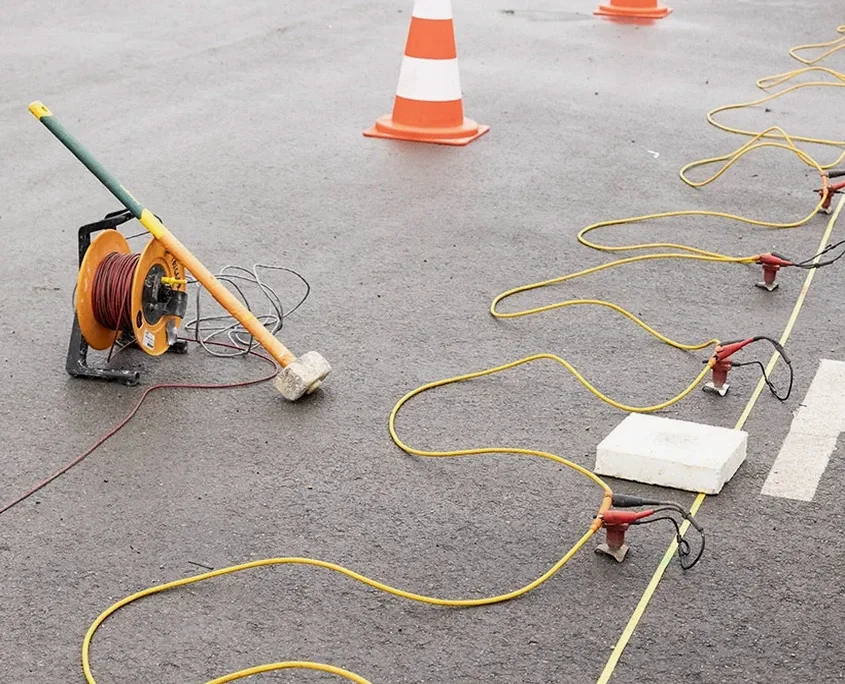
Lubbock's steady expansion westward and southward has pushed development into areas where the near-surface geology tells a complicated story. The city sits perched on the edge of the Llano Estacado, with the Ogallala Formation and Blanco Formation often masked by Quaternary playa lake deposits and windblown sand. When the old Reese Air Force Base lands started transitioning into research parks, the limitations of isolated borings became obvious—you cannot always capture the lateral pinch-outs of the caliche caprock or the buried paleochannel sands that plague the western corridors. Seismic tomography—both refraction and reflection—gives us a continuous cross-section of the subsurface, with P-wave velocity contrasts that map exactly where the caliche transitions into the underlying claystone. For deeper infrastructure near the Canadian River breaks, combining seismic refraction surveys with targeted CPT soundings has proven the fastest way to correlate stratigraphy without drilling dozens of test holes.
Seismic velocity is not just a number—it is a proxy for stiffness, saturation, and fracturing. In Lubbock, the caliche velocity tells you more about excavation difficulty than any boring log alone.
Local ground factors
The semi-arid South Plains climate creates a soil moisture profile that shifts dramatically between summer convection storms and winter dry spells, and that directly affects seismic velocity. After a heavy thunderstorm event—Lubbock averages around 18.5 inches of annual rainfall, but much of it falls in isolated bursts—the uppermost 2 to 3 meters of sandy soil can saturate, dropping P-wave velocity by 20 to 30 percent compared to dry conditions. If you run a refraction line right after a rain event without correcting for moisture, your interpreted depth to caliche can be off by a meter or more. We time surveys carefully and use velocity inversion modeling that accounts for this vadose-zone effect, and we routinely compare refraction results with reflection profiles that are far less sensitive to near-surface saturation. In areas mapped as playa lake basins—there are dozens of them scattered across Lubbock County—the risk of missing a soft clay lens under the caliche is high enough that we recommend liquefaction assessment only as a complementary check, not as a substitute for a good tomographic image.
Reference standards
ASTM D5777–18: Standard Guide for Using the Seismic Refraction Method, ASTM D7128–18: Standard Guide for Using the Seismic Reflection Method, ASCE/SEI 7-22: Minimum Design Loads and Associated Criteria, Chapter 20 site classification requiring Vs profiles, IBC 2021 (adopted by City of Lubbock): Section 1613 referencing ASCE 7 site classification, TxDOT Geotechnical Manual, Chapter 4: Geophysical methods for pavement and bridge foundation investigations
Common questions
How much does a seismic tomography survey cost for a typical Lubbock commercial site?
For a commercial lot in Lubbock—say 2 to 5 acres with a single refraction spread and limited reflection coverage—the fee generally falls between US$3,060 and US$5,810. The spread depends on line length, whether we use a weight drop or explosives, and the depth of investigation needed. Sites requiring both refraction and reflection with detailed velocity analysis will sit near the upper end of that range.
Can seismic tomography detect the thickness of the caliche caprock across my site?
Yes, and that is one of the most common questions we get from structural engineers in Lubbock. The velocity contrast between well-cemented caliche (above 3,000 m/s) and the underlying Ogallala claystone or sand (1,200 to 2,000 m/s) produces a strong refracting horizon. Refraction tomography maps the top-of-caliche and its base with good lateral resolution, and we often supplement it with a few shallow borings to confirm the velocity interpretation.
How long does a seismic survey take, and does weather affect scheduling?
Fieldwork for a single refraction line on a typical Lubbock lot takes half a day to a full day, depending on spread length and access. We avoid scheduling right after heavy rainfall—the saturated near-surface layer reduces velocity contrast and degrades first-break picking on refraction records. High wind, common in spring, can also be an issue for reflection work because it couples noise into the geophones; we generally plan acquisition for early morning when wind speeds across the South Plains are lower.