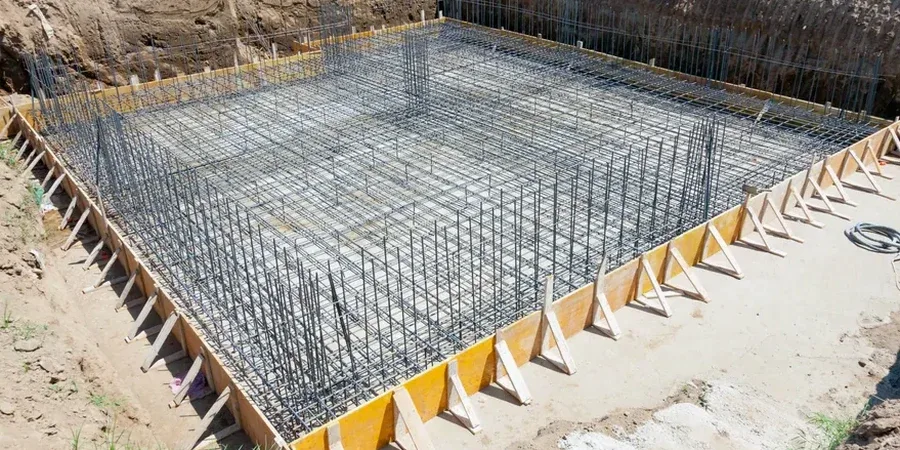
The contrast between a century-old pier and beam home in Tech Terrace and a new slab on grade in South Lubbock can be stark after a few wet-dry cycles. One shifts and groans with the seasons while the other performs uniformly, and that difference often comes down to the foundation approach. Lubbock sits atop the Blackwater Draw Formation, where clay layers with a liquid limit exceeding 50% and plasticity index above 30% dominate the shallow subsurface. The engineering response to this is a properly designed mat foundation. Drawing on subsurface data from across the Llano Estacado, the team approaches each project by first understanding how the soil will move before deciding on slab thickness, rib depth, and reinforcement layout for a raft system that resists differential heave as a single rigid body.
A raft foundation in Lubbock must handle not just the total magnitude of clay heave but the differential movement across the slab footprint — the real threat to superstructure performance.
Local ground factors
With Lubbock sitting at an elevation of approximately 3,200 feet and experiencing over 260 sunny days per year, the surface clays undergo severe desiccation cracking followed by rapid moisture intake during seasonal storms. The 2021 freeze event, which brought temperatures down to -6°F, reminded the local engineering community that frost depth and cold-weather concrete curing must be factored into raft foundation sequencing. The most common failure seen in under-designed slabs across Lubbock is edge lift heave at the perimeter, where the soil moisture gradient is steepest. A rigid mat foundation controls this by spanning across localized soft spots and distributing column loads so that differential settlement stays below the ½-inch over 30 feet threshold that drywall and brick veneer can tolerate. Ignoring the suction profile of the upper 10 feet of Blackwater Draw clay leads to remedial underpinning costs that easily exceed the initial investment in a properly engineered mat.
Common questions
Why is a raft foundation often recommended over strip footings in Lubbock?
The high-plasticity clays of the Blackwater Draw Formation undergo significant volume change with moisture fluctuation. Strip footings at different depths or under different moisture regimes can heave unevenly. A raft foundation acts as a stiffened plate, bridging over localized soft zones and distributing structural loads so that the entire building moves more uniformly, which protects the superstructure from racking and cracking.
What does a mat foundation design typically cost for a residential project in Lubbock?
Engineering fees for a detailed mat foundation design package, including soil-structure interaction analysis and sealed construction drawings, generally fall in the US$1,050 to US$4,390 range. The final figure depends on slab footprint, number of ribs, and whether post-tensioning is required. This covers the design phase; construction costs are separate and vary with concrete and steel volumes.
How do you determine the required rib depth for a stiffened raft on expansive clay?
The rib depth is calculated from the predicted differential heave profile, which comes from soil suction testing and oedometer swell tests. Using methods consistent with PTI DC10.5 and local track record on the Llano Estacado, we model the soil as an elastic medium with a variable moisture-driven swell potential. The beam depth is then selected to limit angular distortion to acceptable levels, typically between 24 and 48 inches in Lubbock’s CH clays.