← Home · Foundations

Pile Foundation Design in Lubbock, TX

Together, we solve the challenges of tomorrow.

LEARN MORE →

Lubbock sits on the Southern High Plains, where the near-surface geology is dominated by Pleistocene-age Blackwater Draw Formation clays. These clays swell when wet and shrink during drought. Anyone who has worked on a commercial slab here knows the pattern. The seasonal volume change can shear a poorly designed shallow footing in one cycle. That is why pile foundation design in Lubbock often bypasses the active zone entirely. We extend the bearing stratum 15 to 25 feet below grade, anchoring into the deeper Ogallala Formation or caliche layers that remain stable year-round. SPT drilling logs from the site confirm refusal depth and help us select the right pile type before we model axial capacity. A design that ignores the local clay mineralogy will fail, and it will fail fast.

A pile that terminates in the active clay zone is not a deep foundation. It is a future liability.

Our approach and scope

Temperature swings on the Llano Estacado add another constraint. Lubbock averages over 260 freeze-thaw days per year, which accelerates moisture migration in the upper 8 feet of soil. A pile cap here needs protection against frost heave and desiccation cracking. We specify concrete mixes with 5% to 7% air entrainment and minimum 4,000 psi after 28 days, per ACI 318. For drilled shafts, we often recommend a minimum diameter of 24 inches to resist lateral loads from wind. The IBC requires a factor of safety of 2.5 for deep foundations under sustained compression. We verify this with CPT testing profiles that give us continuous tip resistance and sleeve friction, eliminating the gaps you get with SPT alone. When the soil profile shows a caliche cap over loose silts, we model the pile as end-bearing on rock, not friction in the overburden.
Pile Foundation Design in Lubbock, TX
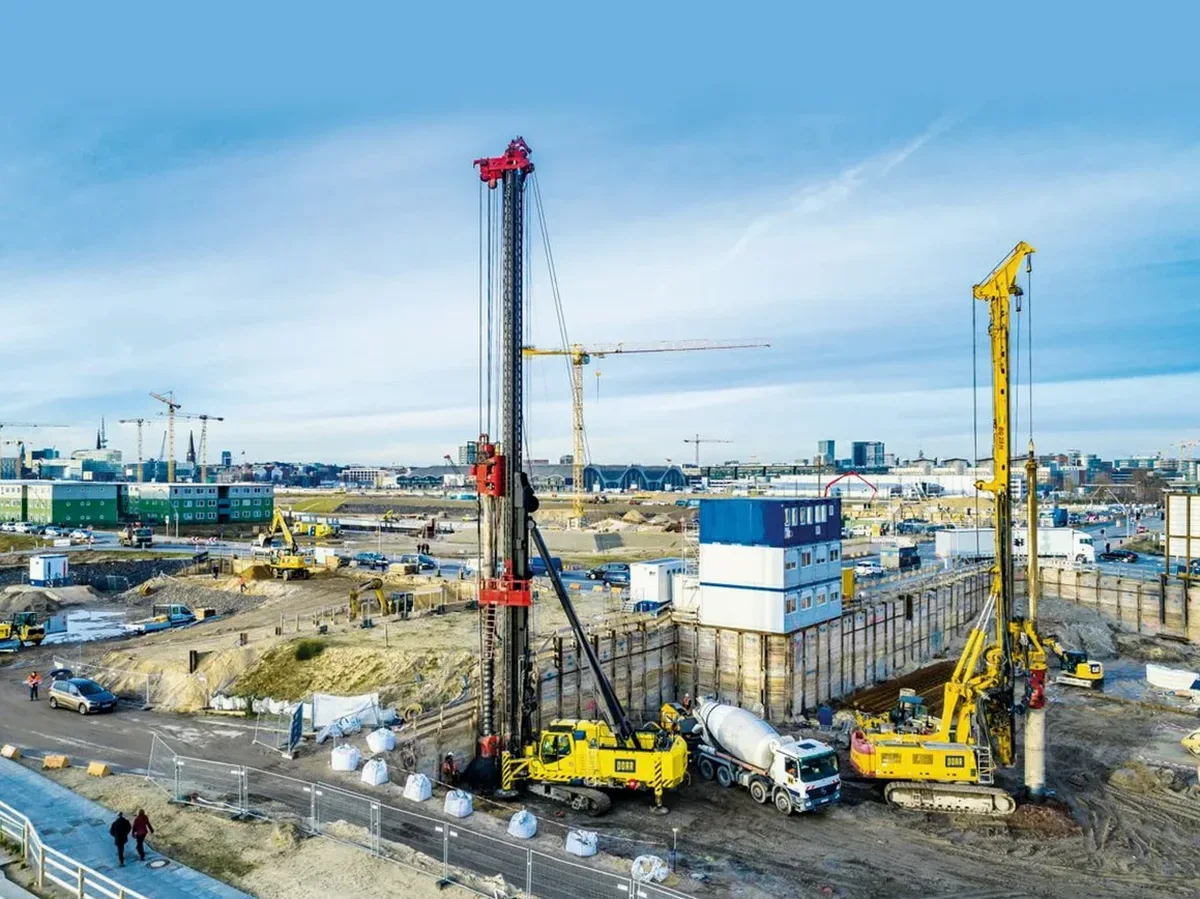
Technical reference image — Lubbock

Local ground factors

Lubbock's expansion since the 1960s has pushed construction into former playa lake basins. These closed depressions collect runoff and fine-grained sediment. The subsurface in a playa margin often contains 10 to 20 feet of high-plasticity clay with organic lenses. Conventional soil reports from the 1980s sometimes missed these lenses because they sampled at 5-foot intervals. A pile tip terminating in an organic layer will settle differentially under load. The structural frame then racks. Repair means underpinning or complete pile replacement. Spending one extra day on a targeted boring program, with sampling every 2.5 feet through the transition zone, eliminates this risk before the first yard of concrete goes in the ground.

Need a geotechnical assessment?

Reply within 24h.

Email: info@geotechnicalengineering.sbs

Typical values

ParameterTypical value
Minimum pile embedment depth (expansive clay)15-25 ft below grade
Design reference standardIBC Chapter 18 / ASCE 7-22
Concrete strength for cast-in-place piles4,000 psi minimum (ACI 318)
Factor of safety (sustained compression)2.5 (IBC requirement)
Typical drilled shaft diameter24-48 inches
Lateral load analysis methodBroms or p-y curves (LPILE)
Soil investigation minimum depth10 ft below pile tip

Related services

01

Axial Capacity Analysis

We compute skin friction and end-bearing using the beta method for clays and the Nordlund method for granular layers. Results are calibrated against CPT data from the site.

02

Lateral Load & Deflection Modeling

Wind and seismic lateral loads are resolved with LPILE or GROUP software. We generate p-y curves for each soil layer and report deflection at the pile head under service and factored loads.

03

Pile Integrity & Load Testing

Design verification includes cross-hole sonic logging for drilled shafts and static load tests per ASTM D1143. We write the testing protocol and interpret the load-settlement curve.

Reference standards

IBC Chapter 18 (Soils and Foundations), ASCE 7-22 (Minimum Design Loads), ACI 318 (Building Code for Structural Concrete), ASTM D1586 (Standard Penetration Test), ASTM D2487 (Unified Soil Classification)

Common questions

What is the cost range for pile foundation design on a commercial building in Lubbock?

Design fees for a typical commercial pile foundation in Lubbock run from US$1,650 to US$5,800. The spread depends on the number of pile groups, the complexity of the soil profile, and whether lateral load analysis is required. A single-tenant retail box with uniform subsurface conditions falls on the lower end. A multi-story structure with variable soil strata and tight deflection tolerances moves toward the upper end.

How deep do piles need to go in Lubbock to bypass the expansive clay?

Most designs target a tip elevation between 15 and 25 feet below finished grade. The exact depth depends on the thickness of the Blackwater Draw Formation at your site. We identify the base of the active zone using Atterberg limits and moisture content profiles from continuous sampling.

Which load cases does ASCE 7 require for pile design?

ASCE 7-22 requires checking dead, live, wind, and seismic loads in combination. For Lubbock, wind governs most commercial projects because the basic wind speed is 115 mph per the ASCE 7-22 hazard map. Seismic loads are lower, but still evaluated under Section 12.8. Each pile group is checked for axial compression, uplift, and lateral shear under the controlling load combination.

Do you design both driven piles and drilled shafts for Lubbock soils?

Yes. Drilled shafts are more common here because they perform well in stiff clay and caliche. Driven piles can be specified where schedule is tight, but pre-drilling is often necessary to penetrate the caliche cap. We evaluate both options during the feasibility phase and recommend the method that minimizes risk for the specific subsurface profile.
Location and service area

We serve projects in Lubbock and surrounding areas.

View larger map