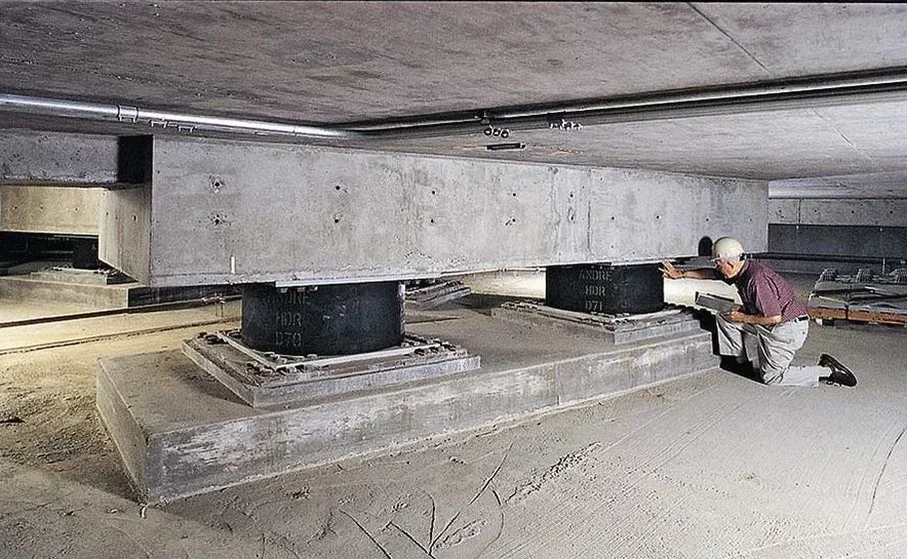
Every seismic design decision in Lubbock starts with understanding the local ground. The city sits at 3,256 feet elevation on the Llano Estacado, underlain by Quaternary windblown sands and the notoriously expansive Blackwater Draw Formation clays. A 2021 USGS update placed Lubbock County in a zone where design spectral accelerations for a 2,475-year event can exceed 0.15g at short periods — low by West Coast standards, but the soil amplification here changes everything. Soft clay basins on the South Plains can double peak ground acceleration at certain frequencies. That's why we don't just specify isolators; we first tie the seismic microzonation data to the foundation soil profile. We run site-specific response analyses because the IBC generic Site Class D assumptions often misrepresent what drill cores actually show beneath Lubbock's post-1950 commercial corridors. The target is practical: keep a hospital or data center operational the day after the design earthquake. The approach starts with ground truth.
Tuning an isolation system to Lubbock ground motion means pushing the structure's period past 2.5 seconds — beyond the amplification range of the Blackwater Draw clays.
Common questions
What is the typical cost range for base isolation seismic design on a Lubbock project?
For a mid-size critical facility in Lubbock, the geotechnical investigation and isolation design phase typically runs between US$4,710 and US$7,140. The total installed isolation system cost depends on building size, number of isolators, and bearing type, but our design fees cover site-specific ground motion analysis, soil characterization, and coordination with the structural engineer through peer review.
Why does Lubbock need base isolation if the seismic hazard looks low on national maps?
The USGS hazard maps show bedrock motion. Lubbock's thick soil column — particularly the Blackwater Draw Formation clays — can amplify short-period ground motion significantly. A moderate earthquake 50 miles away can produce building damage here that the maps alone would not predict. Isolation addresses that site amplification directly.
Which types of structures in Lubbock benefit most from base isolation?
Hospitals, emergency operations centers, data centers, and laboratory buildings with sensitive equipment see the strongest return on investment. These are structures where post-earthquake functionality is non-negotiable, and where the cost of downtime or contents damage exceeds the isolation system cost several times over.
How does the expansive clay in Lubbock affect isolator performance?
Expansive clays create two challenges. First, seasonal moisture cycles cause vertical movement that must be accommodated in the isolator moat and utility connections. Second, the stiffness degradation under cyclic loading changes the foundation impedance used in the isolator model. We measure both effects with site-specific lab testing and include them in the analysis.
What testing is required for isolators per IBC and ASCE 7?
ASCE 7-22 requires prototype testing of at least two full-scale isolators per type, with loading protocols that simulate the design earthquake displacement history. Production testing covers 100% of isolators for vertical stiffness and a sample for horizontal properties. We support this by defining the geotechnical boundary conditions and reviewing test setup against the site-specific ground motion report.