← Home · Laboratory

Laboratory CBR Testing for Pavement Design in Lubbock, Texas

Together, we solve the challenges of tomorrow.

LEARN MORE →

The most expensive mistake we see in Lubbock pavement projects starts with a guess. A contractor lays down caliche base, compacts it to what looks solid, and skips the lab soak. Six months later, the first rain cycle swells the fines and the asphalt cracks along Broadway. That repair bill dwarfs the cost of a proper CBR evaluation. Our laboratory runs the California Bearing Ratio test as specified in ASTM D1883, measuring the actual strength of your compacted subgrade and base materials after a four-day saturation period that simulates the worst field conditions. For projects near Yellowhouse Draw where moisture lingers, we often recommend pairing the CBR with a grain size analysis to confirm the percentage of fines before finalizing the pavement section. The number tells you exactly what thickness of flexible or rigid pavement the soil can support without deforming under traffic loads.

Running the CBR test on dry specimens alone is a trap. The soaked value is what the pavement actually feels after Lubbock's spring thunderstorms.

Our approach and scope

The Southern High Plains surface geology across Lubbock County is dominated by the Blackwater Draw Formation—a mix of sandy loam, clay loam, and cemented caliche layers that behave unpredictably when wetted. We collect bulk samples from your borrow pit or subgrade cut, process them through a No. 4 sieve, and compact five-point moisture-density curves to establish the optimum moisture content. Each specimen gets compacted in a 6-inch CBR mold at modified Proctor effort, then submerged in water for 96 hours with a surcharge ring simulating the pavement weight. The penetration test follows at 0.05 inches per minute using a calibrated load frame, and we plot the pressure-versus-penetration curve to read the ratio at 0.1 and 0.2 inches. For projects specifying undercut and replacement with select fill, we cross-check the soaked CBR against the sand cone density test results from the field to verify that the lab compaction target matches achievable site conditions. The entire test sequence runs about five working days from sample receipt to certified report.
Laboratory CBR Testing for Pavement Design in Lubbock, Texas
Technical reference image — Lubbock

Local ground factors

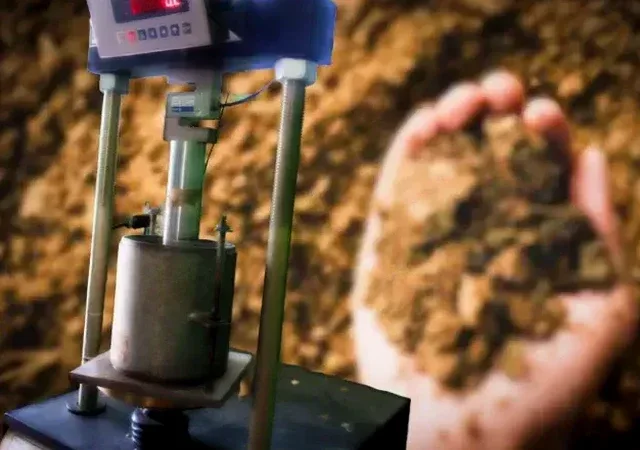
The CBR frame in our lab is a steady-load machine with a 10,000-pound capacity load cell and a piston traveling at exactly 0.05 inches per minute—no faster, no slower. That speed is non-negotiable because rate effects can inflate the bearing ratio by 15 to 20 percent on silty material. We had a project off Quaker Avenue where the contractor's quick-and-dirty CBR came back at 12 percent, but our soaked test with correct surcharge and full saturation gave 4.5 percent. That gap meant the difference between a 6-inch aggregate base and a 14-inch stabilized section. The risk isn't just cracking; it's structural rutting within the first two years. Lubbock's freeze-thaw cycles between November and March compound the damage when water trapped in the base layer expands and destroys the asphalt bond. A proper lab CBR, run with patience and the full four-day soak, gives the pavement designer a number they can trust when running the AASHTO 1993 empirical equation or the MEPDG layer analysis.

Need a geotechnical assessment?

Reply within 24h.

Email: info@geotechnicalengineering.sbs

Typical values

ParameterTypical value
Test standardASTM D1883-21
Mold diameter6 in (152.4 mm)
Compactive effortModified Proctor (56,000 ft-lbf/ft³)
Soaking period96 hours submerged with annular surcharge weights
Penetration rate0.05 in/min (1.27 mm/min)
Reported valuesCBR at 0.1 in and 0.2 in penetration, swell percentage, dry density, moisture content
Typical local soils testedCaliche gravel, sandy clay (CL), silt with sand (ML), crushed limestone base

Related services

01

Subgrade CBR evaluation

We compact native soil from your Lubbock site at optimum moisture and run the full 96-hour soaked protocol. You receive the CBR value at 0.1 inch penetration, swell percentage, and dry density, ready for input into TxDOT or City of Lubbock pavement thickness design charts.

02

Base course and select fill CBR

For crushed limestone, caliche, or imported select fill, we run the test at modified Proctor density to confirm the material meets the minimum soaked CBR specified in your geotechnical report—typically 20% for flexible base and 80%+ for high-quality aggregate.

03

Stabilized material CBR with additive

When cement or lime stabilization is required for Lubbock's expansive clay subgrades, we mix the additive at the specified percentage, compact, cure, and soak before testing. This confirms the stabilized CBR target is achievable before field application begins.

Reference standards

ASTM D1883-21 — Standard Test Method for California Bearing Ratio (CBR) of Laboratory-Compacted Soils, ASTM D1557-12(2021) — Standard Test Methods for Laboratory Compaction Characteristics of Soil Using Modified Effort, AASHTO T 193 — Standard Method of Test for The California Bearing Ratio, IBC Chapter 18 — Soils and Foundations (referenced for allowable bearing pressure correlation)

Common questions

How much does a laboratory CBR test cost for a Lubbock project?

A single-point CBR test with the full four-day soak, including the moisture-density relationship curve, runs between US$140 and US$180 per specimen. If you need a three-point CBR curve to develop a strength-versus-density trend for the design report, the total is proportionally higher. We can quote your exact scope once we know how many borrow sources or subgrade locations require testing.

How long does the CBR test take from sample drop-off to report?

Count on five to six working days. Day one we run the Proctor compaction curve to find optimum moisture. Days two through five are the 96-hour soak under surcharge. Day six we run the penetration test, dry back the specimen, and issue the signed report. We can expedite if you authorize weekend soaking; call us to coordinate.

Do you need undisturbed samples for the CBR test?

No, the laboratory CBR test uses remolded, compacted specimens. We need about 50 pounds of disturbed material per test point, bagged and labeled with the source location. If you need CBR on undisturbed in-place soil, that would be a field CBR using ASTM D4429, which we can discuss separately depending on your site access and pavement type.
Location and service area

We serve projects in Lubbock and surrounding areas.

View larger map