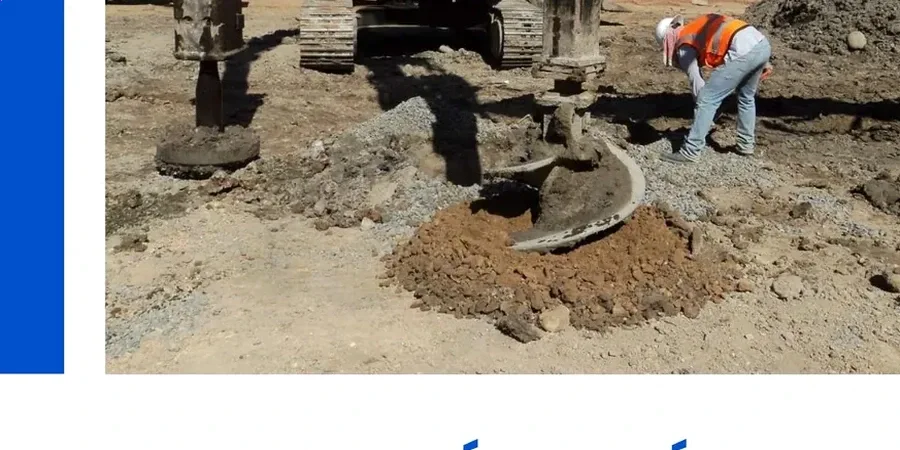
A lot of contractors in Lubbock make the same mistake. They see a building pad with decent blow counts in the upper five feet and assume the ground is uniform. Then the first wet season hits. That stiff crust hides a layer of soft, high-plasticity clay that loses strength fast when moisture goes up. We have pulled cores across the city — from south of 82nd Street to east of I-27 — and found the same pattern over and over. A rigid footing might survive. A lightly loaded slab might crack but hold. But a warehouse column grid or a three-story structure? That needs more than hope. Stone column design gives you a way to reinforce the weak zone and transfer load to something competent. We size the columns for settlement control, not just bearing. And we verify every assumption with CPT testing before the rig ever shows up on site.
Stone columns in Lubbock work when you design for confinement — lose that and you are just filling holes with gravel.
Our approach and scope
Soil behavior in Lubbock changes fast over short distances. North of Loop 289 you find more residual clay and caliche float. South and east, toward Slaton, the near-surface clay gets deeper and softer. That contrast matters when you are designing a stone column layout. In the north, columns often act as stiff inclusions in a relatively competent matrix. In the south, the same design philosophy fails because the surrounding soil offers almost no confinement. We adjust the replacement ratio, column length, and aggregate gradation based on where you are building. A typical installation uses clean, crushed stone — ASTM #57 or similar — placed by bottom-feed vibroflot or rammed-displacement methods. We specify gradation tight enough to prevent clay migration but open enough to drain. For every project we run settlement estimates under the actual structural loads, not generic charts. And we always compare the stone column option against alternatives like rigid inclusions or overexcavation so you know the cost-benefit tradeoff.
Common questions
What soil conditions in Lubbock make stone columns the right choice?
The classic case is a profile with 10 to 25 feet of soft to firm clay overlying denser sand or caliche. When the clay has undrained shear strength between 350 and 1000 psf, stone columns can reinforce it effectively. We also use them on loose silty sand where vibro-replacement densifies and drains at the same time. Sites with very soft clay below 350 psf need extra analysis — sometimes a load transfer platform or a different ground improvement method.
How long does stone column installation take on a typical Lubbock commercial site?
For a site with 200 to 400 columns at 20-foot depth, a single bottom-feed rig can install 25–40 columns per shift. That puts total installation at one to two weeks, plus a few days for load testing. Wet weather slows things down — the clay gets sticky and the rig needs more cleanup between columns.
What does stone column design cost for a project in Lubbock?
Design fees typically run between US$1,500 and US$5,830 depending on project size, number of column layouts, and how much field verification is needed. A small retail pad with one uniform grid is on the lower end. A multi-story structure with variable loads and phased construction falls on the higher end.
Do stone columns help with expansive clay in this part of Texas?
Partially. Stone columns do not stop clay from swelling — they create vertical drains that let moisture equalize faster and reduce differential heave. They also stiffen the soil mass so total heave is distributed more evenly. For highly expansive sites in Lubbock we often combine stone columns with a moisture barrier or a stiffened slab to control movement.