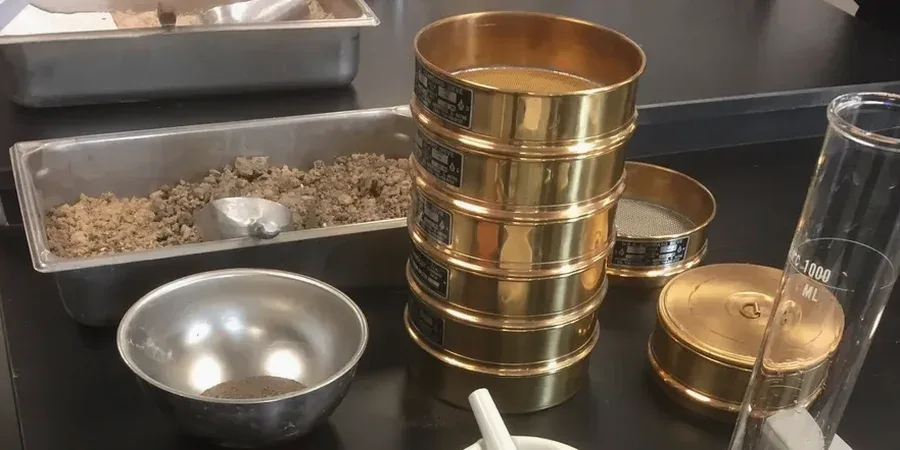
At 3,256 feet above sea level, Lubbock sits on the caprock of the Llano Estacado, where the soil profile can shift from wind-blown silt to caliche-rich clay within a single lot. We have seen projects stall because the gradation curve was assumed rather than measured. A complete grain size analysis, combining mechanical sieving with the hydrometer test, gives us the full particle-size distribution from coarse sand down to the finest silt and clay. This data feeds directly into the Unified Soil Classification System (USCS) per ASTM D2487, which then governs everything from drainage design to bearing capacity. For Lubbock's characteristic loess and residual soils, skipping the hydrometer portion means missing the fines that control shrink-swell behavior. When we need to correlate these results with in-situ strength, we often pair the lab work with SPT drilling to build a complete geotechnical model from the ground down.
In Lubbock's loess and clay, the hydrometer test is not optional; it is the only way to quantify the silt and clay fraction that drives volume change.
Our approach and scope
The difference between a site near Yellow House Canyon and one out on the flat plains east of the city is striking. Near the canyon, you find more silty sands and occasional gravel lenses from ancient playa deposits; out east, the soil is dominated by thick, reddish-brown clay with high plasticity. A sieve-only analysis in the canyon zone might correctly show 65% sand, but a combined sieve-and-hydrometer test on the eastern clay reveals 40% passing the No. 200 sieve, which entirely changes the foundation recommendation. In our experience, the hydrometer reading after 24 hours of sedimentation is what separates a low-risk site from one requiring special moisture conditioning. For pavement design on Texas Department of Transportation projects, this full gradation curve is non-negotiable. Where we suspect fill or deeper variability, we also run a test pit investigation to verify the stratigraphy visually before sampling, ensuring our lab specimens truly represent the layers that matter for construction.
Local ground factors
The most costly mistake we see in Lubbock is a geotechnical report that classifies a soil as 'silty sand' based on a quick field shake test, without the hydrometer to confirm the actual clay content. A contractor then places a slab-on-grade with standard compaction, and two years later the floor is cracked because the 'silty sand' was actually a clayey silt with high expansion potential. The ASTM D2487 classification hinges on the percentage passing the No. 200 sieve, and you simply cannot get that number accurately from sieves alone when the soil contains significant fines. Another common failure is designing drainage for a retention pond using only the sand fraction, ignoring the low permeability driven by the silt and clay distribution. A proper grain size analysis in Lubbock, with both sieve and hydrometer, prevents these misclassifications and gives the civil engineer the true coefficients of uniformity and curvature needed for filter design and seepage analysis.
Common questions
Why is the hydrometer test necessary for Lubbock soils, and not just a sieve analysis?
Because Lubbock sits on the Llano Estacado, where wind-deposited loess and clayey residuum dominate much of the subsurface. A sieve analysis stops at the No. 200 sieve (0.075 mm) and cannot distinguish between silt and clay. The hydrometer test measures particle sizes down to 0.001 mm, giving us the actual clay fraction. Without it, a highly expansive clay could be misclassified as a low-plasticity silt, leading to an under-designed foundation. The ASTM D2487 classification system requires this fine-grained distribution for any soil with 12% or more passing the No. 200 sieve, which is almost all of our local soils.
What does a complete grain size analysis cost for a typical residential project in Lubbock?
For a standard combined sieve and hydrometer analysis on a single sample, the fee ranges from US$90 to US$210, depending on the number of specimens and whether we need to pretreat for organics or carbonates. A typical residential investigation with three samples generally falls within this range per sample. We always deliver a firm quote after reviewing the project scope and soil conditions.
How long does the hydrometer test take to run?
The sedimentation portion requires a minimum of 24 hours to capture the full settling curve, with readings taken at specific intervals: 0.5, 1, 2, 4, 8, 15, 30, 60, 120, 240, and 1440 minutes. Adding sample preparation, pre-soaking in dispersant, and data reduction, the complete hydrometer analysis is typically reported within 2 to 3 working days from receipt of the sample in our lab.
How do you take the soil sample so it represents the layer we are building on?
We coordinate directly with the drilling crew or excavation contractor to sample from specific depths identified in the field logs. For a combined sieve-and-hydrometer test, we need approximately 500 grams of material for sandy soils and a minimum of 200 grams for fine-grained soils. The sample must be sealed immediately in a moisture-tight container to preserve the natural water content. We recommend sampling at every distinct stratigraphic change and at the proposed foundation bearing elevation.