← Home · Underground Excavations

Geotechnical Design of Deep Excavations in Lubbock: Managing Weak Caliche and High Plains Soils

Together, we solve the challenges of tomorrow.

LEARN MORE →

The Southern High Plains present a unique set of constraints for deep excavation work. Lubbock sits on the Llano Estacado, a vast plateau where the Ogallala Formation dominates the subsurface profile. This formation mixes cemented caliche layers with loose aeolian sands. The contrast is stark. A drill bit will hit rock-hard caprock at 5 feet then plunge through uncemented sand at 15 feet. This vertical variability demands a design approach that anticipates abrupt changes in soil stiffness. A uniform shoring section rarely works across the entire cut depth. We often pair pre-excavation site characterization with stratigraphic profiling to map the caprock continuity before selecting a support system. For excavations that extend below the perched water table present in some Lubbock basins, a CPT test provides near-continuous data on pore pressure dissipation and helps define the dewatering strategy early in the design phase.

Caliche in the Ogallala Formation transitions from intact weak rock to granular soil within the same excavation face. A single earth pressure coefficient never captures the full behavior.

Our approach and scope

Our design methodology follows ASCE 7-22 for load combinations and the IBC 2021 edition adopted by the City of Lubbock. The critical design parameter here is lateral earth pressure distribution through caliche. Caliche behaves as a weak rock when intact but degrades to granular soil when fractured. Applying a standard Rankine active pressure envelope without accounting for this degradation overestimates the factor of safety in the short term and underestimates long-term wall deflection. We use a bilinear pressure distribution for mixed-face conditions typically encountered along Loop 289 and the Marsha Sharp Freeway corridors. The design must also handle expansive clay seams—members of the Randall Series—that swell upon moisture ingress. These clays can impose swelling pressures exceeding 15 kPa on soldier pile lagging. Where the excavation depth exceeds 20 feet, we integrate tieback anchors or internal bracing, and often specify a slope stability analysis to verify global stability for adjacent structures founded on shallow footings.
Geotechnical Design of Deep Excavations in Lubbock: Managing Weak Caliche and High Plains Soils
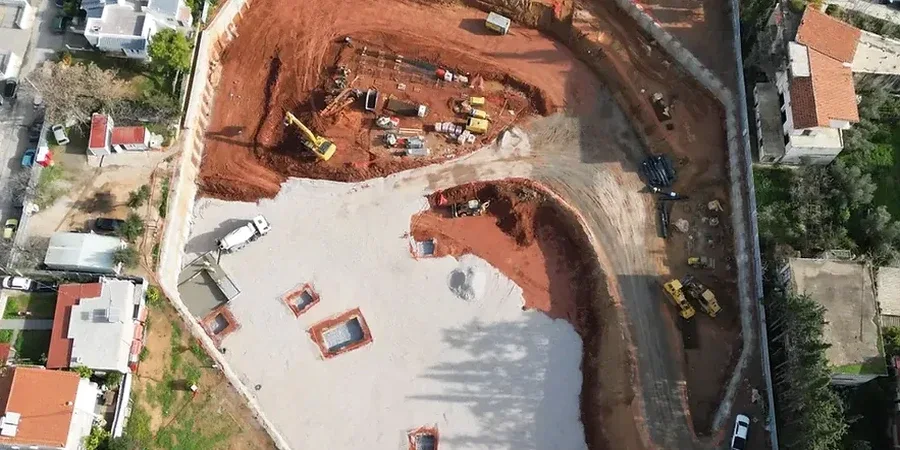
Technical reference image — Lubbock

Local ground factors

A 40-foot excavation near the Texas Tech University Health Sciences Center encountered a discontinuous caprock layer that was fully intact on the north wall and completely absent on the south wall. The original design assumed uniform caliche at 8 feet. The south wall began to ravel within hours of cutting through the sand pocket. We had to implement a contingency plan that included immediate shotcrete facing and additional tieback rows to limit deformation to less than 1 inch at the adjacent street. This scenario repeats across Lubbock. The Ogallala caprock is not a continuous stratum; it lenses out unpredictably. Ignoring this depositional reality leads to face instability and ground loss. For excavations adjacent to existing slab-on-grade construction—common in Lubbock’s commercial districts—even small ground movements open joints and cause differential settlement. A well-instrumented monitoring plan with inclinometers and optical survey points is not optional. It is the primary risk control measure.

Need a geotechnical assessment?

Reply within 24h.

Email: info@geotechnicalengineering.sbs

Typical values

ParameterTypical value
Maximum excavation depth analyzedUp to 65 ft (20 m) in mixed caliche/sand profiles
Design earth pressure methodBilinear envelope for mixed-face caliche; Peck 1969 apparent pressure for soft clay seams
Caliche unconfined compressive strength (intact)1.5 to 8 MPa (lab tested per ASTM D7012)
Expansive clay swell pressure (Randall Series)12 to 28 kPa (ASTM D4546 Method C)
Active design groundwater levelSeasonal perched water at 18–30 ft below grade in playa-adjacent zones
Wall deflection limit (cantilever)0.5% of excavation height or 2 inches, whichever is less
Applicable seismic coefficient (kh)0.10–0.15 for Site Class D per ASCE 7-22 Chapter 11

Related services

01

Soldier pile and lagging design

Drilled shaft soldier piles with timber or shotcrete lagging for cuts up to 35 feet. We specify pile embedment below subgrade to resist toe kickout in loose sand layers beneath the caliche.

02

Tieback anchor systems

High-capacity grouted anchors for wide excavations where internal bracing obstructs construction sequencing. Anchor bond length is designed in the caliche or deeper sand based on load test verification.

03

Excavation support and monitoring plans

Complete submittal package including wall deflection criteria, dewatering specifications, and instrumentation layout with trigger levels for contingency action.

Reference standards

ASCE 7-22 Minimum Design Loads and Associated Criteria for Buildings and Other Structures, 2021 International Building Code (IBC) as adopted by Lubbock, ASTM D7012 Standard Test Methods for Compressive Strength and Elastic Moduli of Intact Rock Core Specimens, ASTM D4546 Standard Test Methods for One-Dimensional Swell or Collapse of Soils, FHWA Geotechnical Engineering Circular No. 4: Ground Anchors and Anchored Systems

Common questions

How does caliche affect deep excavation design in Lubbock compared to normal soil?

Caliche acts as a weak rock with unconfined compressive strengths from 1.5 to 8 MPa. Its stiffness reduces lateral pressures in the short term, but it is brittle and fractures as the cut weathers. The design must assume a transition from rock behavior to granular soil behavior over the construction period. We use a bilinear pressure envelope to cover both conditions and specify shotcrete facing to preserve the caprock's cohesive strength.

What is the typical cost range for a geotechnical deep excavation design package in Lubbock?

The design fee depends on excavation depth, number of support levels, and instrumentation requirements. For a typical 25-foot excavation with soldier piles and one row of tiebacks, the engineering design package ranges from US$2,270 to US$7,330. A deeper cut with multiple anchor rows and a full monitoring plan will be at the higher end of that range.

Do I need a dewatering design for a deep excavation in Lubbock?

It depends on proximity to playa lakes. Perched groundwater exists at 18 to 30 feet below grade in many parts of the city, especially east of Interstate 27. If your excavation bottom is below the seasonal high water table, you need a dewatering plan to prevent base instability and piping in sand layers beneath the caliche.
Location and service area

We serve projects in Lubbock and surrounding areas.

View larger map