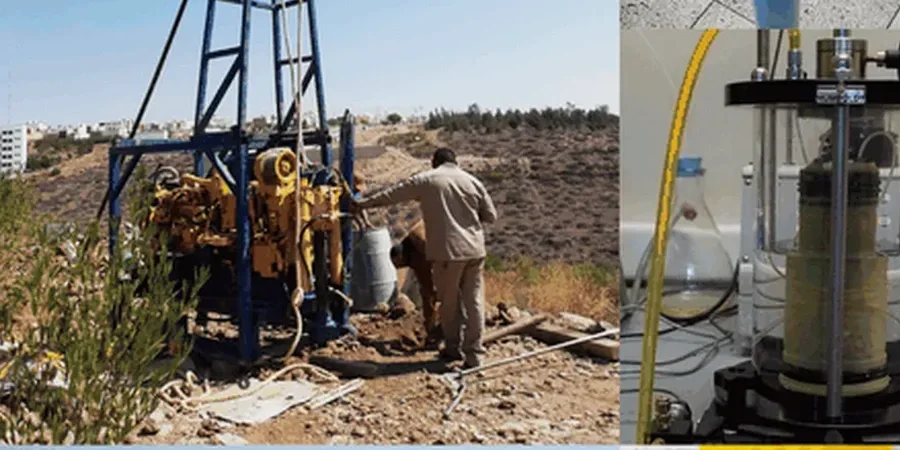
Lubbock sits at an elevation of 3,256 feet on the High Plains, where the soil profile tells a story few contractors read until it is too late. Over 260,000 people live atop a blanket of Quaternary wind-blown silt underlain by the Ogallala Formation caprock caliche, and this layering creates a geotechnical puzzle that standard site investigations often miss. A proper soil mechanics study here is not a bureaucratic checkbox; it is the difference between a slab that stays level for decades and one that cracks within two seasons. Our team runs programs based on ASTM D2487 classification and IBC Chapter 18 requirements, pulling undisturbed Shelby tube samples and running triaxial shear on the lacustrine clays that appear in the playa lake basins scattered across the Llano Estacado. We have seen moisture swings in the upper 12 feet that can heave a lightly reinforced footing by over an inch just between August and February, so we design the lab program to quantify that exact volumetric sensitivity before the first yard of concrete arrives.
Caliche in Lubbock can carry 8,000 psf or crumble at 2,500 psf depending on a cementation gradient that changes every 18 inches—you cannot interpolate it from a neighboring lot.
Local ground factors
The drill rig we mobilize for Lubbock soil mechanics studies is a track-mounted CME-75 with automatic SPT hammer, and we outfit it with a hollow-stem auger string that can cut through caliche crust without washing out the fines below. The real risk on the High Plains is not structural collapse; it is differential movement caused by moisture migration under a covered slab. When you pave over a playa-edge lot and the perimeter landscaping drips irrigated water into the silty clays, the center of the slab stays dry while the edges swell, and that curl can snap a post-tensioned tendon. We have logged moisture contents of 22 percent under a leaky irrigation valve 10 feet from a foundation corner while the rest of the subgrade sat at 11 percent, and the resulting heave differential exceeded 1.5 inches across a 40-foot dimension. Our soil mechanics report maps the expansive potential zone by zone, so the structural engineer can specify variable rib depths, moisture barriers, or a lime-treated subgrade bench that keeps the active zone moisture profile within a range the slab reinforcement can handle.
Reference standards
ASTM D2487-17e1 Standard Practice for Classification of Soils for Engineering Purposes (Unified Soil Classification System), ASTM D1586-18 Standard Test Method for Standard Penetration Test (SPT) and Split-Barrel Sampling of Soils, ASTM D4829-21 Standard Test Method for Expansion Index of Soils, IBC 2021 Chapter 18 Soils and Foundations, Section 1803 Geotechnical Investigations, ASCE 7-22 Minimum Design Loads and Associated Criteria for Buildings and Other Structures, Chapter 12 Seismic Design Data
Common questions
How much does a soil mechanics study cost for a typical single-family lot in Lubbock?
For a standard residential lot inside the city limits, a complete soil mechanics study including two borings to 25 feet, Atterberg limits, expansion index, moisture profile, and a foundation recommendation letter typically runs between US$3,540 and US$4,620. The final number depends on access constraints, caliche thickness encountered, and whether the structural engineer requests triaxial shear or additional swell testing. We deliver a fixed-price proposal after a brief site walk, and we do not invoice for extra lab work unless the client specifically asks us to expand the scope.
What makes Lubbock soils different from other parts of Texas for foundation design?
Three factors set Lubbock apart. First, the surface soils are predominantly wind-blown silt from the Blackwater Draw Formation, not the high-plasticity clay you find in the Dallas or Houston areas, so the swell mechanism here is more about moisture-driven collapse than classic clay expansion. Second, the caliche caprock from the Ogallala Formation creates a rigid layer at highly variable depths, sometimes 3 feet, sometimes 15, which means bearing capacity can change dramatically across a single building pad. Third, the playa lake basins that dot the city introduce localized zones of saturated, high-plasticity clay that behave entirely differently from the surrounding upland silts. A soil mechanics study that does not account for these three interacting conditions will miss the controlling geotechnical risk on the site.
How deep do you drill for a soil mechanics study in Lubbock, and what do you do when you hit caliche?
For most residential and light commercial projects, we take borings to a minimum of 25 feet or until we penetrate 5 feet into competent caliche, whichever is deeper. When the hollow-stem auger hits caliche refusal, we switch to a rock core barrel and attempt to recover a continuous core through the caprock layer, because we need to log fractures, voids, and the degree of cementation. If the caliche is too fractured to core cleanly and we lose circulation, we record the depth, note the refusal on the boring log, and often recommend a CPT sounding adjacent to the boring to get a continuous tip resistance profile through the problem zone. The goal is to confirm whether the caliche can serve as a bearing stratum or whether it is just a thin, discontinuous crust over softer material.