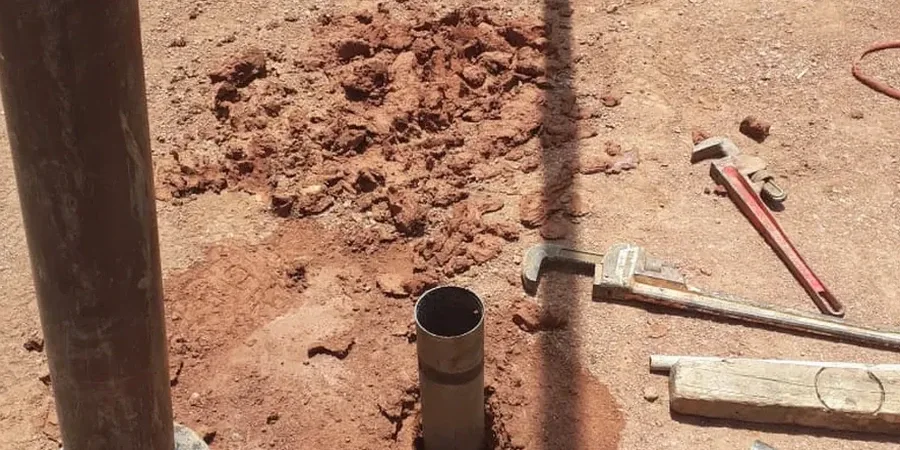
The Llano Estacado, where Lubbock sits at an elevation of roughly 3,256 feet, presents a paradox—an ancient plateau capped with a thin calcrete layer that masks a complex subsurface of Quaternary alluvial deposits and intermittent lacustrine clays from the city's numerous playa lakes. When an engineered infiltration basin fails to drain or a deep excavation encounters unexpected perched water, the culprit often lies in the undisturbed hydraulic conductivity of these formations. While laboratory tests on Shelby tube samples deliver a starting point, only a field permeability test captures the true mass hydraulic behavior, accounting for fissures, sand lenses, and the secondary porosity that dominates flow in the Ogallala Formation's relict sediments. The Lefranc method, employed in saturated soils within boreholes, and the Lugeon test, a pressurized water system designed for fractured rock or stiff clays, allow our technical team to measure transmissivity directly—generating the data required for dewatering system design, groundwater modeling, and compliance with Texas Commission on Environmental Quality (TCEQ) regulations.
On the caliche-capped plateau of Lubbock, a Lugeon value derived under staged pressure reveals whether fractures close with depth or remain open conduits for groundwater flow.
Our approach and scope
The hydrogeological contrast between a site near the Lubbock International Airport and one adjacent to Yellow House Canyon illustrates why a single design permeability value rarely applies across the city. At the airport, the caliche caprock—a dense, nodular calcium carbonate layer—often requires a Lugeon test under staged pressure increments (typically 1, 2, and 3 bar) to distinguish matrix flow from fracture dilation. The test records water take in liters per minute per meter of test interval, and a Lugeon value below 3 suggests tight rock suitable for unlined reservoir floors. In contrast, the silty clays of the Blackwater Draw Formation, encountered in many residential subdivisions southwest of Loop 289, demand the constant-head or variable-head Lefranc technique. Here, the cavity is isolated with a packer assembly and water is introduced to measure steady-state flow, calculating k values that often fall in the 10^-5 to 10^-7 cm/s range—critical for sizing retention ponds under the City of Lubbock's drainage criteria manual. This variability means every site-specific investigation, often paired with a test pit program to visually log stratigraphy, becomes the foundation of a defensible geotechnical report.
Local ground factors
Since 1942, when Lubbock's population was under 32,000, the city has grown to over 260,000, pushing development onto marginal land with shallow perched water tables that complicate basement construction and utility trenches. A contractor excavating near a playa lake without permeability data risks catastrophic slope instability as positive pore pressures reduce effective stress in the silty banks. Our team has observed projects where an assumed k of 1x10^-6 cm/s—based on a desktop review—proved optimistic by an order of magnitude once field tests measured the true anisotropic flow through desiccation cracks. The consequence was a temporary dewatering system that required three times the pumping capacity, incurring change orders that delayed completion. By executing Lefranc tests at the proposed excavation invert elevation and correlating results with SPT drilling logs, engineers establish a defensible pore pressure model that satisfies ASCE 7-22 groundwater load combinations and prevents the structural distress that accompanies unanticipated buoyancy forces.
Common questions
What is the typical cost range for a field permeability test in Lubbock?
A field permeability testing program in Lubbock, including mob-demob of a drill rig, packer assembly, and execution of Lefranc or Lugeon tests at multiple depth intervals, typically ranges from US$720 to US$1,140. The total depends on the number of test intervals, whether the hole is advanced through hard caliche requiring a rock bit, and if the test is performed in a new borehole or an existing monitoring well.
When is a Lugeon test required instead of a Lefranc test?
A Lugeon test is specified when the formation is rock, cemented caliche, or stiff fractured clay where the test interval can remain stable without a slotted screen. The method uses a pneumatic packer to isolate a section of the borehole and applies water under pressure. In Lubbock, this is common for dam foundation investigations in Yellow House Canyon or for assessing the grout take in fractured calcrete layers beneath proposed mat foundations.
How does the Lefranc method account for the smearing of the borehole wall during drilling?
To minimize the smear effect, particularly in the silty clays of the Blackwater Draw Formation, our technical team advances the borehole using hollow-stem augers with a sacrificial tip, then withdraws the plug to create a natural cavity. The test interval is then developed by gentle surging to remove any remolded material before the constant-head test begins. If the formation is collapsible, we use a prepacked sand filter around the test section to ensure the measured permeability reflects the undisturbed formation, not the disturbed annulus.
Can field permeability results be used directly in a MODFLOW groundwater model?
Yes, the hydraulic conductivity values measured via Lefranc or Lugeon tests represent a point estimate of horizontal permeability that can be assigned to model layers. However, because the Llano Estacado aquifer is highly heterogeneous—with braided stream channels cutting through finer overbank deposits—it is standard practice to run multiple tests across a site and apply geostatistical interpolation (kriging) rather than relying on a single arithmetic mean, which could overestimate the bulk transmissivity of the formation.